
Why is it that two similar people with similar backgrounds can experience the same trauma and have vastly different responses to it, such that one person ends up permanently disabled by overwhelming symptoms of PTSD while the other, seemingly, is fine? This is the question that sits at the heart of so much trauma counselling in Calgary and across Alberta.1
More importantly, do both people have something to teach us? Are there skills and techniques involved, and can we learn steps for coping with damaging and even life-threatening situations so we come out strong, resilient and able to continue to live and love? These are the same questions that show up in counselling for trauma survivors in Calgary every single week.2
Calgary Trauma Counselling: 7 Steps for Surviving Severe Trauma
Just two months ago today, I was headed towards our local Costco to purchase our groceries for the week. As I approached one of the last few intersections before my destination, the light turned red, and I came to a stop. The light turned green, and I began to move into the intersection when a large black truck (which was clearly doing well over the speed limit) swerved into the turning lane and then, running a red light, swerved again directly into my path.
I hit my brakes and managed to avoid being T-boned, but the dual wheels on the side of the truck tore into the front of my van at an angle. The truck’s speed was so high that its rear axle and drive shaft were ripped out from under it, thankfully absorbing a lot of the force of the impact.
While I thought (to be honest, mostly convinced myself) that I was fine at the scene of the accident, that soon proved not to be the case, both physically and, more importantly, emotionally and mentally. Later that night, as the physical pain started to set in and I tried to drug myself to sleep, my brain began to replay the sequence of events that had happened earlier that day. As any trauma recovery therapist in Calgary will tell you, this is often the moment when early trauma symptoms begin to surface.3
Over and over again, the same sequence would play out: I would manage to get into a somewhat comfortable position and begin to drift off to sleep. I would enter the early stages of sleep, and then my brain would replay the three snapshot images it had recorded of the event:3

A picture of the left passenger-side headlight, grill, and fender, headed towards me.

A brief picture of the black shape of the passenger side doors in front of me.

An image of my hood crumpling and the oversized fender coming towards my face, coupled with the physical sensation of being violently thrown forward towards it.
I would then jerk awake in a cold sweat with my heart pounding and gasping for breath, and then the cycle would repeat. After about 90 minutes of this, it started to dawn on me that I was in serious trouble. While this wasn’t yet diagnosable as Post Traumatic Stress Disorder (PTSD), all of the signs were already there, and perhaps it was time for me to use for myself some of the trauma therapy techniques I teach my clients all day as a counsellor who works extensively in trauma in Alberta.1
So, what is trauma therapy anyway?
Trauma therapy is arguably the oldest form of psychological treatment on the planet. While the founders of many trauma-related therapeutic interventions may claim to have originated them, their claims are laughably false, and most of the more reputable clinicians (eg, Peter Levine, Gabor Mate, Richard Schwartz) will freely admit to having stolen their ideas from a millennia of tribal practices, rituals and shamanic healers of old.4
 And even those more “clinical” approaches are themselves long predated by how humanity learned to intervene in damaged/traumatized sexuality, an area where Ros and I do so much work.
Take, for example, the Tantric sexual practices developed in ancient India. The ugly reality of ancient India (sadly still too common today) is that a huge number of 8-year-old girls were routinely “married” off to men three times their age.
While their sociology (the study of what it means to be a people and have a culture) may have approved of this, those little girls’ anthropology (what it means to be human) screamed in horror at what was unquestionably child sexual abuse. Tantra can be seen as an attempt to provide trauma therapy for such, not unlike the way modern childhood trauma therapy in Calgary and beyond tries to restore safety and dignity to abused children. White puts it so succinctly when he states:
…exorcism, divination, and healing have historically been the most pervasive forms of Tantric practice, and it has been [pursued] in their roles as ritual healers, “psychoanalysts,” clairvoyants, and ground-level problem solvers5 P.30
While premodern Tantric traditions were religious and ritual systems rather than clinical psychotherapies, modern trauma and sex-therapies and their mindfulness and body-based approaches for reducing PTSD symptoms are so eerily parallel to tantric-inspired practices that they are increasingly becoming recognized as almost a one-to-one match. Whether someone walks into EMDR trauma counselling in Calgary, somatic trauma therapy, or another evidence-based model, the underlying principles are surprisingly consistent.6 7 8
All trauma therapies work by helping the nervous system complete the survival responses that were interrupted at the moment of threat. They bring the body and mind back into connection, allowing the traumatic memory to be safely revisited, reorganized, and integrated so it no longer overwhelms the present. At their core, trauma therapies transform raw fear into regulated awareness, restoring agency, safety, and emotional coherence.4 6
| Category | Tantric Sexual Practice (Traditional / Neo-Tantric) | Mindfulness-Based Therapy for Sexual Trauma |
|---|---|---|
| Core Orientation | Sacred erotic ritual as a pathway to expanded body/partner consciousness and energetic unification. | Somatic and cognitive methods to restore safety, reduce dissociation and promote body awareness.9 |
| Breathwork | Rhythmic, synchronized “circular” or alternate-nostril breathing; breath used to center and reregulate both partners move energy (prana) between partners and along the spine (kundalini). | Slow diaphragmatic or paced breathing, body-scan-linked breath for nervous-system regulation and trauma titration. These are the foundation of Polyvagal-informed therapy, attachment-based models.10 |
| Touch Practices | Ritualized, mindful, non-goal-oriented touch (maithuna, yoni/lingam puja, massage) to awaken sensitivity and reverence. | Gradual, trauma-informed re-introduction of safe touch via sensate-focus or guided self-touch, emphasizing consent and safety. This is central to Somatic therapies, trauma-informed yoga, mindfullness.11 |
| Eye Gaze / Presence | Sustained mutual gazing to dissolve ego boundaries and cultivate attunement. | Mindful eye contact (or alternatives) to rebuild tolerance for intimacy without triggering hyperarousal. Eye work itself is central to EMDR.7 |
| Meditation Focus | Visualization of inner channels (chakras) and connection with the present; mantra repetition to induce mental calm and altered states. | Present-moment awareness, labeling sensations, non-judgmental observation; body-scan and loving-kindness for self-compassion. Paced Breathing/Vagal Toning and activating the parasympathetic system via breath, humming, or gentle exhale extension is almost universally used in early stabilization.10 |
| Energy Flow / Somatic Awareness | Attention to sexual energy moving through chakras; bandhas and breath to circulate arousal without climax. | Interoceptive tracking to distinguish arousal from threat; grounding to prevent dissociation. Awareness and naming of autonomic nervous system response is foundational to CBT, DBT and Narrative therapy-based approaches.12 13 14 |
| Movement / Posture | Ritual postures (asana) with mudra and mantra; sometimes partner yoga. | Trauma-sensitive yoga, mindful movement, and grounding postures emphasizing choice and safety. Used in disaster and emergency trauma response globally.11 15 |
| Sound / Voice Use | Mantra, seed syllables, toning to vibrate energy centers; paired with breath and gaze. | Gentle vocalization (humming, sighing) as grounding to support vagal tone and reconnection. This is nearly identical to most forms of Sensorimotor Psychotherapy.16 |
| Arousal Regulation |
Edging/retention to transform pleasure into meditative awareness (“sexual alchemy”). |
Exposure-based tolerance building: noticing arousal as sensation, practicing self-soothing rather than avoidance or compulsion. Edging/retention are similar to modern practices of Titration & Pendulation involving small, manageable “doses” of trauma activation followed by settling.6 |
| Partner Dynamics | Symbolic polarity work (e.g., Shiva/Shakti), synchronized intention, ritual roles. | Empathic co-regulation with therapist or partner; attunement without sexualized role-play. These rituals install positive memories or coping imagery to strengthen inner stability before trauma recall.17 |
| Intention Setting | Sacred invocation, creation of ritual space, honoring divine energy in self/partner in modern terms is simply called Containment Imagery. | Psychoeducation and collaboratively defined goals; safety plans/agreements instead of ritual vows. Central to modern trauma-focused, hypnosis-based interventions is the visualization of “containers” or symbolic spaces to safely hold intrusive material between sessions.18 |
| Aftercare / Integration | Ritual closure (bowing, mantra, grounding), symbolic cleansing and gratitude. | Post-session grounding, journaling, self-care routines, review of triggers and boundaries. Again, these are universally used in early and later-stage stabilization.4 |
| Tools / Aids | Altars, candles, incense, yantras and oils provide environmental cues of sacredness. | Calm, safe environment; optional guided audio/apps; minimal stimulation to avoid overwhelm. This is psychological first-aid, emphasizing safety and stabilization.15 |
While humanity has an immense history in addressing complex trauma, the principles of effective trauma therapy are often effectively used by people who have no idea that what they’re treating is trauma or that they are implementing a form of trauma self-therapy. The most resilient people among us are not somehow tougher than the rest of us; rather, they have learned to experience and process trauma more effectively – often entirely by themselves. In modern terms, what we now call complex trauma counselling in Alberta is often a more structured version of what human beings have always done to survive. Let’s look at how they do that.2
Trauma self-therapy: Crisis intervention.
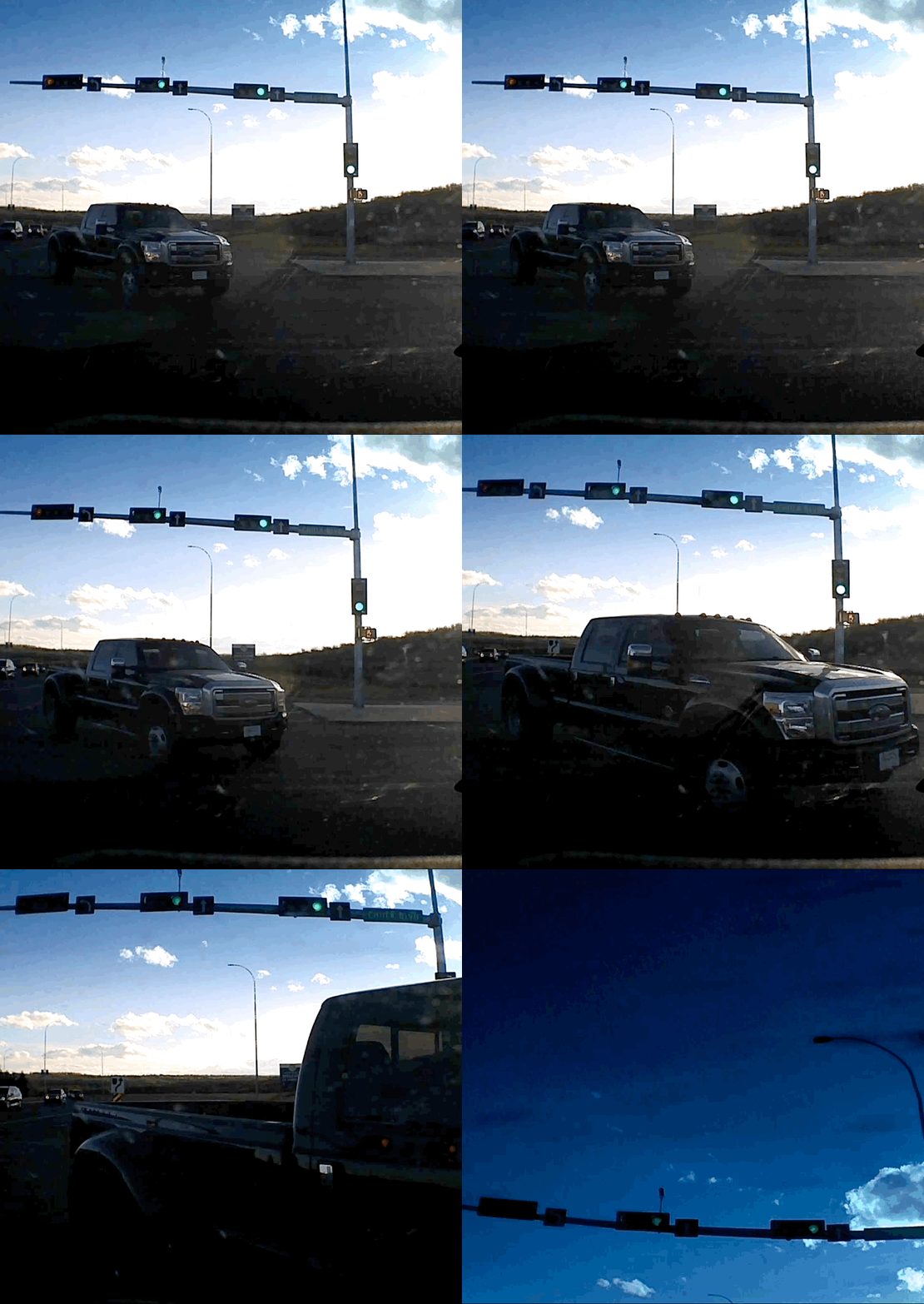
(Click to play)
When I got downstairs to my office, the first thing I did was download the video from the dash-cam and (foolishly) decided to watch it from start to finish. All it took was one viewing of the video to put me into a full-blown mind-body reaction – coupled with an intense dissociative panic attack. Other than fully confirming my suspicions about the harm I had experienced, that only made the problem worse. In addition to feeling unsafe and dysregulated, I had now also flooded myself by violating most of the key principles all forms of trauma therapy have in common.6 19
Virtually every trauma therapy has seven core principles in common.
- Safety precedes exposure. Trauma cannot be processed in a body that still perceives threat. Safety turns off the survival system long enough for the deeper work to begin, making every other step possible.419
- Regulation before exploration. If the nervous system is dysregulated, exploring traumatic material only retraumatizes. Regulation provides the stability needed to observe, feel, and integrate without being overwhelmed.10 6
- Processing is titrated, not flooded. The brain integrates trauma in small, digestible doses. Gentle “sips” of activation allow the system to complete what was interrupted without being pushed back into fight, flight, or freeze.6 19
- Therapeutic relationship as a co-regulation system. Humans regulate best in connection. A calm, attuned other becomes a stabilizing anchor, helping the client’s nervous system return to balance when it drifts toward panic or collapse.17
- Integration over catharsis. Raw emotional release may feel powerful, but without integration it changes nothing. True healing happens when the brain reorganizes the traumatic memory into a coherent story that no longer overwhelms.6 14
- Body and mind treated as a single system. Trauma is stored physiologically as much as psychologically. Working with breath, posture, sensation, and thought together creates the conditions for lasting change and prevents emotional bypassing.6 16
- Empowerment and consent replace passivity and reenactment. Trauma takes away choice. Healing gives it back. Allowing the client full agency at every step restores dignity, control, and the internal sense of “I can handle this now.”4 15
Once I reregulated myself, I started on the steps needed to deal with this properly. What follows is the same kind of framework I use in my own practice, providing trauma counselling in Calgary, and that many clients later learn to apply for themselves.
Step 1: My first step was to reconnect with my own body.
Using techniques of Somatic Experiencing, Polyvagal approaches and breath and body-focused Yoga, I laid down on the floor and began to get in touch with my (rather hurting) body. Not only was I using awareness of breathing, feet, posture, and muscle tone to counter dissociation, but I was also further extending the regulation I had already achieved. These are the same nervous-system tools I often teach in somatic trauma therapy in Calgary sessions.6 10 11
- Somatic Experiencing: Tracking and initial pendulation. I started by noticing the smallest, simplest sensations: the weight of my heels against the floor, the way my ribs expanded on each inhale, the subtle vibration in my hands. Instead of forcing myself to relax, I let my attention move back and forth (a mild, entry-level start into what SE calls pendulation) between areas of tension and areas of ease. The contrast itself began to soften the tightness. I did not push. I just tracked, waited, and let my nervous system settle on its own timeline.6
- Polyvagal approaches: Vagal glides and safety signals. I then shifted into Polyvagal work by intentionally sending safety cues to my own body. I lengthened my exhale slightly more than my inhale, letting my breath fall out of me like a long sigh. I let my eyes soften into peripheral vision, a simple but powerful safety signal for the vagus nerve. Even the act of placing one hand over my sternum and one over my abdomen (a practice I often teach clients) helped cue my system that I was safe, here, now.10
- Breath and body-focused Yoga: Shape, ground, release. Finally, I used gentle yoga-based grounding. I pressed the soles of my feet into the floor and let my knees fall inward slightly, a shape that engaged my core without strain. I allowed gravity to take the full weight of my pelvis and shoulder blades. With each inhale, I imagined widening across my back; with each exhale, I allowed my muscles to release just a little bit more. These micro-releases, barely noticeable if you were not looking for them, were enough to bring me fully back into my body, present and anchored.11

Step 2: Then I began to differentiate what was happening inside of me:
Using techniques called Externalization, Naming and Mindful Interception, I began to observe my various internal sensations, beginning to distinguish discomfort from actual danger. As I was doing this, I added CBT-based steps wherein I consciously assigned labels to parts of the trauma response (“this is just my nervous system reacting”) to restore self-differentiation. This is the same kind of inner literacy people learn in good trauma and anxiety therapy in Calgary: naming, separating, and reframing.13 12 14
- Externalization: Creating distance from the reaction. I started by picturing the fear response as something beside me rather than inside me. Instead of saying “I am terrified,” I imagined setting the feeling on the floor next to me, almost like placing a heavy bag down. This simple shift let me look at it rather than from inside it. The sense of overwhelm softened the moment I stopped merging with the reaction and treated it as something I could observe and interact with.13
- Naming: Labeling the sensations so they lose power. As the sensations rose and fell, I named them plainly and without judgment. “Tightness in my chest.” “Heat in my throat.” “Shakiness in my hands.” Giving each sensation a clear, neutral name kept my mind from jumping into catastrophic stories. The act of naming turned something frightening into something familiar, something measurable, something my body could move through rather than brace against.14
- Mindful Interception and CBT steps: Noticing, labelling, reframing. I then caught the automatic thoughts as they surfaced. When a wave of panic hit, I paused and mentally said, “This is my nervous system reacting. It is not danger.” When an intrusive image flashed through my mind, I countered with, “This is a memory firing, not a threat in the room.” Each time I replaced fear-based interpretations with accurate ones, the emotional intensity dropped. I was training my mind to tell the truth about what was happening, instead of letting the trauma tell the story for me.14

Step 3: Active preparation to expose myself to what I needed to face:
The problem was that I already recognized my brain was not coping well with the memory, and that previously traumatized childhood parts of me were reacting/taking over in ways I was not fully in control of. Fixing this required using Internal Family Systems related techniques to enter and organize my inner world, opening communication with both Primary Protective Parts as well as the childhood parts which were struggling to take over my mind. Each part of me was talked down, placed into a separate and safe inner space and provided with imagery-related resources to understand and cope with what was coming next. This is exactly the kind of deep inner work that often happens in complex trauma counselling in Alberta when early life experiences and present-day triggers collide.8
Internal Family Systems, or IFS, is a way of understanding your inner world as a collection of “parts,” each with its own fears, memories, protective strategies and hopes for you. Instead of forcing these parts to behave or trying to silence them, IFS teaches you to communicate with them the same way you would connect with real people: with curiosity, compassion and respect. When you turn inward, you can meet the parts of you that manage, the parts that panic or fight, and the younger parts that still carry old pain. By listening to them and helping them feel safe, your inner system becomes more cooperative, calmer and more aligned with who you are today.8
- Engaging a Manager part: The hyper-responsible organizer. The first part to step forward was the Manager that usually runs my internal world with strict oversight. It wanted to control the process, analyze the danger, and keep me from making a mistake. I spoke to it directly: “I see what you’re trying to do. You’re trying to keep everything orderly so nothing slips through the cracks.” I thanked it for its work and explained that I was not asking it to disappear, only to step back for a moment so I could deal with what was underneath the reaction. Acknowledging its fear of losing control helped it soften, and the pressure in my chest loosened as this part agreed to give me space.8
- Engaging a Firefighter part: The one that wants to numb everything. The next part to surface was a Firefighter that desperately wanted to shut the entire experience down. It pushed urges toward distraction, scrolling, eating, anything that would drown the feelings. I said to it, “You’re working so hard to put out the fire. You jump in because you think I can’t handle this.” That honesty shifted something. The impulse eased because this part finally felt seen. I reassured it that I was not going to force exposure, that I would go slowly, and that its job was still important. That cooperation helped me stay present without collapsing into avoidance.8
- Engaging the Exile: A childhood part shaped by growing up in a war-torn third-world country. Finally, the Exile appeared, the youngest version of me, shaped in a place where tribal violence, instability, and the sudden loss of safety were constant realities. This part did not speak in words; it showed images and body sensations: the sound of distant gunfire, the instinct to hide, the early belief that the world could turn dangerous in a split second. I knelt beside that part in my mind and said, “You are not alone anymore. I know why you’re terrified. This accident felt like the world collapsing again, but I promise you, we are safe right now.” I internally lifted that child out of the chaos and placed him in a warm, quiet space to rest. For the first time in hours, my body released a deep involuntary breath — the kind that only comes when an Exile finally feels protected.8

Step 4: Graduated and intermittent exposure, so the memory could be properly stored and not return as flashbacks:
Sitting back at my desk, I reloaded the dash-cam file, but this time I set it to play at the slowest possible speed (around 1/10th speed or 3 frames per second) so my mind could begin to process and categorize it.6
As I began to play the video, I repeatedly noticed both mental and physiological levels of arousal increasing. Each time this would happen, I would stop playback, reregulate my body and mind, communicate with any reactive part of my inner world, rename what I was seeing, feeling and experiencing and change the stories I was telling myself about them. This kind of paced exposure is at the heart of many forms of PTSD counselling in Alberta, including EMDR and other trauma-focused approaches.6 7 14
- Pendulation Step 1: Identifying activation before it takes over. The moment I felt the first jolt of activation in my chest, I paused the video. I brought my attention to the part of my body that felt the most stirred up, usually my diaphragm or throat. I stayed with that spot long enough to recognize it, but not long enough to fuse with it. This gentle awareness prevented me from slipping into overwhelm and kept the activation manageable rather than explosive.6
- Pendulation Step 2: Redirecting attention toward a place of stability. After locating the activated area, I shifted my awareness to somewhere in my body that felt neutral or grounded. For me, this was often the weight of my legs against the floor or the sensation of the chair supporting my spine. I let myself rest in that stable place just long enough for my breathing to deepen. Moving attention back to a regulated area helped my nervous system reset and taught my body that activation and safety can coexist without one swallowing the other.6 10
- Pendulation Step 3: Moving between activation and ease to discharge energy. Once my system was calmer, I brought my attention back to the activated sensation, but only for a few seconds. Then I shifted again to the grounded feeling. Back and forth. Activation, then ease. Tightness, then warmth. Fear, then support. Each cycle discharged a little more of the trapped survival energy. Within a few rounds, the intensity that had first spiked through me began to drain away. I could feel my body returning to itself rather than bracing against the memory.6

By the end of this roughly hour-long process, I was able to watch the video at normal speed and feel only fear and sadness – normal emotions for a situation of this type. The memory had become integrated and was now just another part of me. But the task was far from over.6
Step 5: Using clarity to establish empowerment and initiative:
By the end of that process, the source of my trauma response and what my unconscious mind was fleeing from had become a harsh conscious realization: That but for the grace of God, my life would have ended two months ago.
Everyone who has viewed the video has made the same comment: I delayed an abnormally long time after the light changed. Had I accelerated away from the stoplight as I usually do, the front bumper of that truck would have punched through the driver’s door of my van at a speed sufficient enough that even a modern vehicle (which my van was not) couldn’t have protected me.
This is a difficult process called Dual Awareness. It involves being present to the current safety while also engaging the past danger so that I could clearly identify both distorted beliefs (guilt, shame, self-blame) and reframing them while facing and cognitively reappraising the real dangers so I could do something effective with them. It is the same kind of clarity-building work I invite clients into during trauma counselling in Calgary, whether they are first responders, parents, or people simply trying to get their life back after an accident.16 14
- Distorted beliefs: Confronting guilt. One of the first beliefs I had to face was the quiet, poisonous idea that the accident was somehow my fault. In Dual Awareness, I held the fear of that afternoon in one hand and the present moment in the other. I reminded myself that I was stopped at a red light, obeying traffic laws, and that the truck driver was the one who ran the signal at a high speed. When I let both realities sit side by side, the guilt began to lose its authority. The truth was simple: I did not cause this.14
- Distorted beliefs: Releasing shame and self-blame. Shame arrived as a whisper that I should have reacted faster, that a better version of me would have swerved differently or predicted the danger. I slowed these thoughts down and compared them with what was actually possible in the moment. Avoiding a full-size truck racing through a red light at near highway speed would have required superhuman reflexes. When I brought both the memory and the current facts into awareness at the same time, the shame shrank. I stopped punishing myself for not doing the impossible.14
- Cognitive reappraisal: Facing the real danger of driving an older vehicle. Once the emotional distortions softened, I could finally look at the real, practical danger with clear eyes. My old vehicle lacked modern collision-avoidance systems, cross-traffic sensors, and automatic emergency braking. Had I been driving something equipped with those features, the truck may never have reached me. This was not about blame but about truthful evaluation. Dual Awareness allowed me to feel both the vulnerability of that moment and the empowerment of taking action. For the first time, I could acknowledge that updating our vehicle was not an indulgence but a safety decision grounded in the reality of what had nearly happened.14

Step 6: Emotional processing:
But, though I was no longer experiencing a mind-body reaction when viewing the video or thinking about the accident, the emotional pain and loss were still very much present. Some of it was about the physical pain and the financial costs the oh-so-just and equitable insurance system of Alberta was about to inflict upon us, but that barely even mattered. What mattered were the emotions surrounding the future. This is where grief and trauma counselling in Calgary often spends a lot of time: not only with what has happened, but with what could still happen.20
Our society understands the process of grieving the past rather well. We have grief groups, chaplains in hospitals, and every spiritual leader in the country is well versed in walking their parishioners through end-of-life issues. Where they fail is with respect to the future.20
If your grandfather dies, that’s likely a very painful and difficult loss – but he’s definitely never doing that ever again. On the other hand, a rape, loss of a partner or a motor vehicle accident could happen many times over. First responder trauma therapy in Calgary, for example, is often about living in a world where scary things will continue to happen, and yet still choosing to love and show up.
Even just on a physical level, an impact of this nature is an experience nearly impossible to describe. From the punishing bruising of the seatbelt to the transmitted force of the impact on my legs through the floor, the searing pain of overtaxed leg, arm and chest muscles that kept my head from slamming into the wheel and the sensation of all of my internal organs slamming against the inside of my ribcage, as well as my brain feeling stunned from the g-force driving it into the inside of your own skull, it’s all theoretical until you have experienced it. But all of that pales in significance to the emotional level.
Then there is the confusion, the anger at the irresponsibility of the other driver, the fear of the pain itself, the sheer terror at the idea that my wife and children could be left alone and the horrifying possibility that I could have been left paralyzed or even in a vegetative state.
And yes, every time I get behind the wheel of a car, it could happen again, and to drive that car is to accept it. There’s deep sadness and tears there about the future that I needed to experience, grieve and accept to keep on living.20
- Grieving what could still happen. I let myself acknowledge the part of me that was terrified not of what had already occurred, but of what might happen again. Instead of pushing that fear away, I sat with the reality that future losses were possible. I pictured the roads I still had to travel, the intersections, the unpredictability of other drivers, and I let myself feel the grief of living in a world where future harm is never fully off the table. Naming this helped the fear lose its vague, overwhelming shape.20
- Grieving the life I almost lost. I allowed the sadness to surface around the version of my life that could have ended in that intersection. I let myself feel the weight of the “almost”—the nearly-missed birthdays, conversations, mornings with my family. This wasn’t catastrophizing. It was acknowledging the truth: I had come close to losing a life I deeply loved. Letting myself grieve that near-loss brought a surprising sense of softening and gratitude rather than panic.20

Step 7: Cognitive processing/Secondary Cognitive Reappraisal:
During my Graduate School years, one of my favourite professors would often caution us to: “Don’t waste your pain.” To his understanding, “wasted pain” was suffered through but never allowed to change the person for the better.
It’s ok that grief and loss change you; actually, it’s more unlikely that they will not. The grieving process integrates the experiences we have with our larger sense of self so that, while the loss no longer dominates our existence, it becomes part of us, creating a richer sense of self, meaning, and purpose.21 22
One of the key changes I have experienced through this experience has been related to my vehicle purchasing habits. For years, I only purchased later-model vehicles, preferring to have someone else take the 25% write-down from driving a new vehicle off the lot and enjoying the ability to fix them nearly for free with parts from auto wreckers. Though I still refuse to buy a new car, the risks of driving a vehicle without the latest collision-avoidance and safety features are now starkly apparent to me, and I can no longer justify doing so. Modern collision-avoidance systems would almost certainly have prevented this accident.
Another change is related to how my priorities have shifted. When I was lying on the floor of my office processing this, one realization became very clear: Had I been disabled or killed, I would not have regretted making less money or buying fewer toys. I would have regretted not spending time with my wife and children; growing the deepest intimacy possible. Ros and I have already made significant schedule changes to allow this investment.22
Primary Cognitive Reappraisal is about the lies you tell yourself due to the traumatic incident and restoring self-compassion in such. Secondary Cognitive Reappraisal is about aligning your beliefs and your thinking about your life with a changed sense of self, so that all parts of you work together in a coherent life narrative that successfully integrates the trauma. It’s about the restoration of trust, agency, identity, intimacy and connection to life after the trauma is processed, so hyper-vigilance is replaced with an expanded tolerance for pleasure, calm, and joy. In many ways, this is what good trauma and anxiety therapy in Calgary is aiming for: not just symptom reduction, but a different way of being in your own life.14 21
Self directed trauma and PTSD therapy
When trauma strikes, it’s always best to have a trained therapist on your side to guide you through it. But sometimes that’s not possible due to therapist availability, financial or other reasons. In those moments, so many people make self-destructive choices instead of owning their own healing that, more often than not, involve alcohol, drugs or other numbing behaviours. The problem with those numbing behaviours is not only that they don’t work, they also allow a critical window to close, allowing a relatively easily resolved traumatic experience to become a diagnosable mental health disorder. That doesn’t have to be your outcome.23 24
 For thousands of years, untold millions of people have successfully performed trauma therapy on themselves and partners they love – even addressing some of the most complex traumas imaginable, like situations where the partner who is trying to heal another is, in fact, the very cause of his or her trauma. And they did it without even realizing that what they were doing was trauma therapy. The most successful and well-regarded animal rehabilitation specialists use essentially identical techniques, all without a degree in psychology.25
If they can do it, you have so much power to heal yourself!
Once trauma has embedded itself into the soul, it often requires more in-depth help. You don’t have to navigate that path of healing alone. If you find yourself overwhelmed, stuck, or unsure of where to turn next, reach out for support from our Calgary Trauma Counselling services. The same inner wisdom that carried you through the worst moments is still inside you, waiting for guidance, structure and compassion. When you combine that inner strength with the right therapeutic relationship, trauma stops being a life sentence and becomes an inflection point — a place where your story can change. When you are ready, take the next step through our Calgary trauma counselling services. Whether you are seeking PTSD counselling in Alberta, childhood trauma therapy in Calgary, or a grief and trauma counsellor in Calgary who understands complex trauma PTSD treatment, there is healing on the other side, and you deserve to reach it.